
Content and mediaA writer’s angle is only as good as what the audience already said before the piece was written.
What can a system carry in a content and media business?
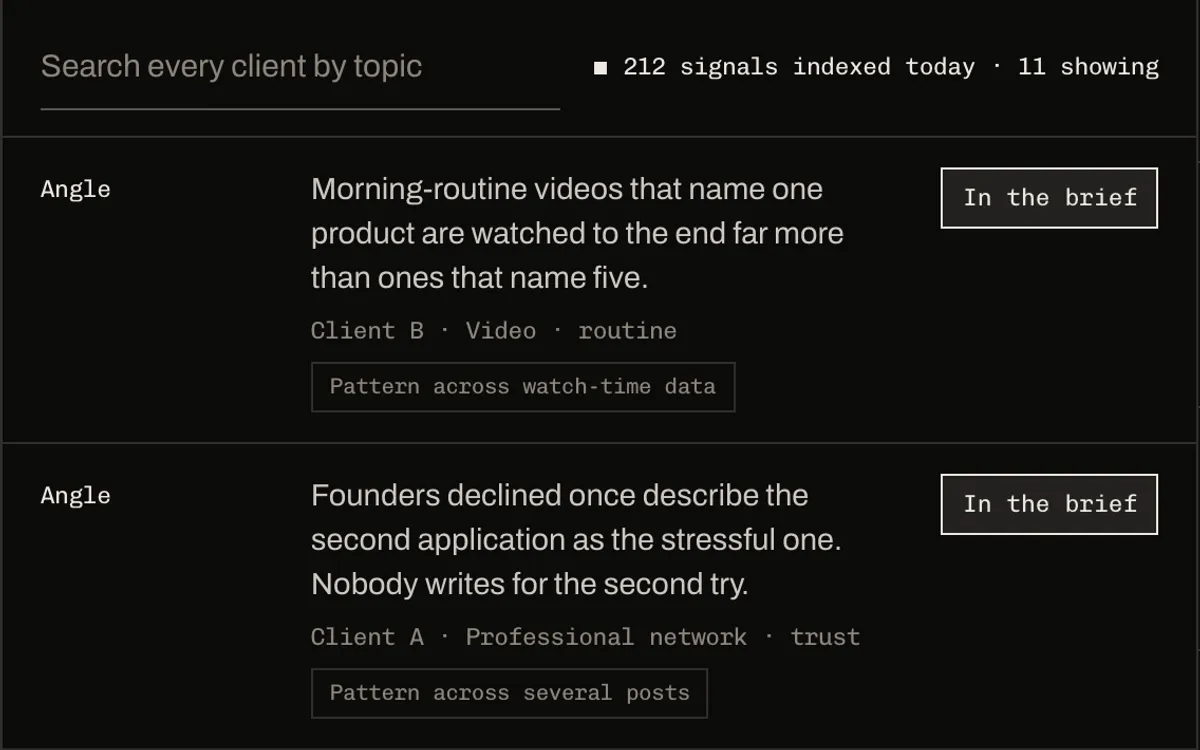
What a writer needs before the piece: what the audience is already asking, in its own words, sorted by topic. A growth system reads across the places an audience talks, scores each thread against a client’s niche, and hands every writer a searchable set of angles before they open a document, instead of a brief built from memory.
How it sounds from inside.
- Every writer starts a piece from a blank page and their own guess at what the audience wants to hear.
- The angle that would have landed is buried in threads and comments nobody has time to read closely.
- A niche moves fast, and by the time a trend is briefed to a writer it has already turned into several other posts.
- Editors know which angles have worked before, but that memory lives in one person’s head, not anywhere a new writer can search.
Growth systems.
The work here is research feeding a person who still writes the piece. That is what a growth system is built for: a niche read across the places its audience talks, sorted by topic and made searchable, so a writer starts from what people are already asking instead of a guess. The writing itself, and every call on tone, stays with the writer.
The boundaryNothing goes out in the company’s name without clearing the line the company draws: a person’s approval, a check on its voice, or a daily window to read the queue and pull anything.
What a growth system is built fromContent and media, as built.
- 01ScanEvery channel, every morning, per client: Reddit, LinkedIn, X, YouTube, news, newsletters and primary documents, including the sources that usually block scripted access.
- 02ClassifyEach item is sorted into a trending angle, a competitor move or a fresh source, and tied to the client it’s for.
- 03ScoreAngles are ranked by what’s rising and what’s still uncontested, so a writer sees the opening, not just the noise.
- 04AssembleA ready brief is drafted per angle: an outline, the sources behind it, and a suggested headline.
- 05IndexEvery item is indexed and searchable by topic across every client, instead of held on one page.
What we would map first.
- Where the audience talks
The places a niche’s audience already discusses it, read for what they ask and argue about.
- Sorted by topic
Every thread placed under the topic it belongs to, so a writer can search instead of scroll.
- The angle, not the draft
What a piece could say that the audience is already asking for, left for the writer to write.
- What changes as the niche moves
Which topics are rising and which have gone quiet, so a brief matches what people are asking now.
Before you commission one in content and media.
- Does it write the piece?
- No. It reads what an audience is already saying and hands a writer the angle. The writing, the voice and every call on tone stay with the writer.
- Which places does it read?
- Wherever the niche’s audience already talks about it. The Consult maps the places that matter for a given niche before anything is built.
- Does it replace an editor’s judgment?
- No. It surfaces what is already being asked and argued; an editor still decides which angle fits the piece and the outlet.
Where would it start in your company?
The first conversation is with the people who would build it. If there is a fit, the Consult comes next.