

Writing28 posts · page 1 of 3
What does it take to run a business on systems?
Mostly it takes counting: the hours that go to rebuilding context nobody needed rebuilt, and the workflows that repeat every week and break quietly when nobody is watching. Each post takes one question at a time, with the systems OCTYN builds and runs as the evidence.
Founder operations3 min
No. 28: A founder time audit should count the questions only you can answer
A founder time audit works when it logs two things for a fortnight: where each hour went, and every question somebody brought you because nobody else knew the answer. Then mark which of those needed your judgement. The ones that did not are hours the operation spent using you as its memory, and they can come back to you.
No. 27: How to prevent accidental data deletion in automated systems: make it refuse
To prevent accidental data deletion in automated systems, make the database refuse any delete that would take other records with it, and have the refusal say what it is blocking. The damaging deletes tend to come from a cleanup step that reports success, so the loss stays hidden until somebody needs the record.
Operations systems3 min
No. 26: Shift handover without losing information: the note gets written too late
A shift handover without losing information needs the record written during the shift, as things happen, so the outgoing person is never asked to recall a whole shift at the end of it. The incoming person reads open items first, with who promised what and by when, and still makes every call on what to do next.
Build or buy3 min
No. 25: AI demo vs production: what week six brings that the boardroom never saw
The gap in AI demo vs production is mostly the cases left out: a demo runs on clean examples somebody picked, and production gets whatever the operation produces that week, including the days you would never choose to show. Before signing, ask to see it run on a bad week of your own records.
Client context3 min
No. 24: Client notes scattered across tools: why a new notes app will not gather them
Client notes scattered across tools stay scattered because each note gets written wherever the person happened to be standing, and a new app only adds one more place. The fix is one record per client, built from what the work already writes, with each note carrying its date and source, so nobody has to file anything later.
Product systems3 min
No. 23: Keeping API keys off the device in a consumer app gives you an off switch
Keeping API keys off the device in a consumer app means every outside call goes through a small function on your own server. The download then holds no key at all, and changing one needs no store release. The price is one more stop on every call, which is worth measuring from the first day.
Growth systems2 min
No. 22: How to keep a consistent brand voice across channels when site managers write
To keep a consistent brand voice across channels, turn the voice into rules a draft can fail, write them from the best writing your people have already done, and check every draft against them and against a current record of what is true. A guide read once at induction will not hold it.
Founder operations3 min
No. 21: The hidden cost of switching between tools is the answer stitched by hand
The hidden cost of switching between tools is mostly in what happens after the switch: a person reads several systems that are each right about their slice, then merges them into one answer, sometimes using facts of different ages. The minutes spent clicking are the small part, and the easiest to count.
No. 20: Rollback plan for an AI workflow: what can still be put back after it acts
A rollback plan for an AI workflow has to say what can be put back after the system acts. Restoring the last working version covers the code. Actions waiting to happen should stay editable until they run, and data already written needs its own answer, because reverting the code does not unwrite anything.
Operations systems3 min
No. 19: Tracking a trade order from quote to delivery without losing status midway
Tracking a trade order from quote to delivery without losing status means keeping one record per order that every step writes into, from the supplier checks through payment, shipping and claims. The record says which step the order waits on and who it waits for, and a person still closes anything that moves money or commits the company.
Build or buy3 min
No. 18: How much does an AI system of your own cost, and what it costs to change later
How much a custom AI system costs comes down to two sums: the build price, and what running and changing it costs after launch. Weigh both against what the work costs your team today, in hours at your own rate. OCTYN quotes its price after a mapping call, fixed and in writing.
Client context3 min
No. 17: How to hand off a client without losing context starts before anyone resigns
To hand off a client without losing context, get what the outgoing person knows into a shared record before anybody resigns, with each fact dated and tied to where it came from. A meeting in the final week collects only what that person remembers to say, which after years on one account is the smaller part.
The systems behind the writing.
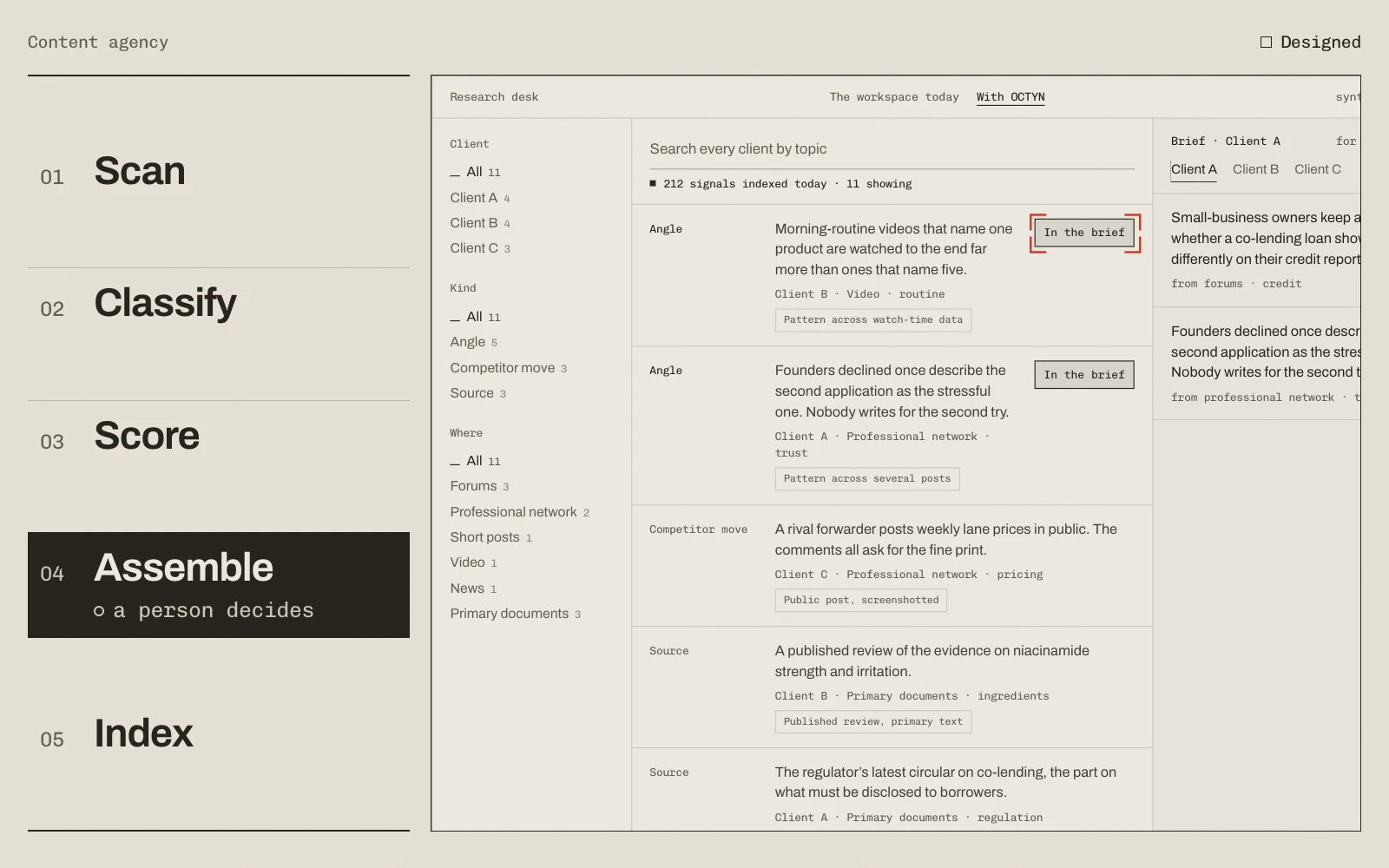
Content agency
Hand every writer the angle before they start.
Each client’s niche is read across the places its audience talks, sorted by topic and made searchable.
Read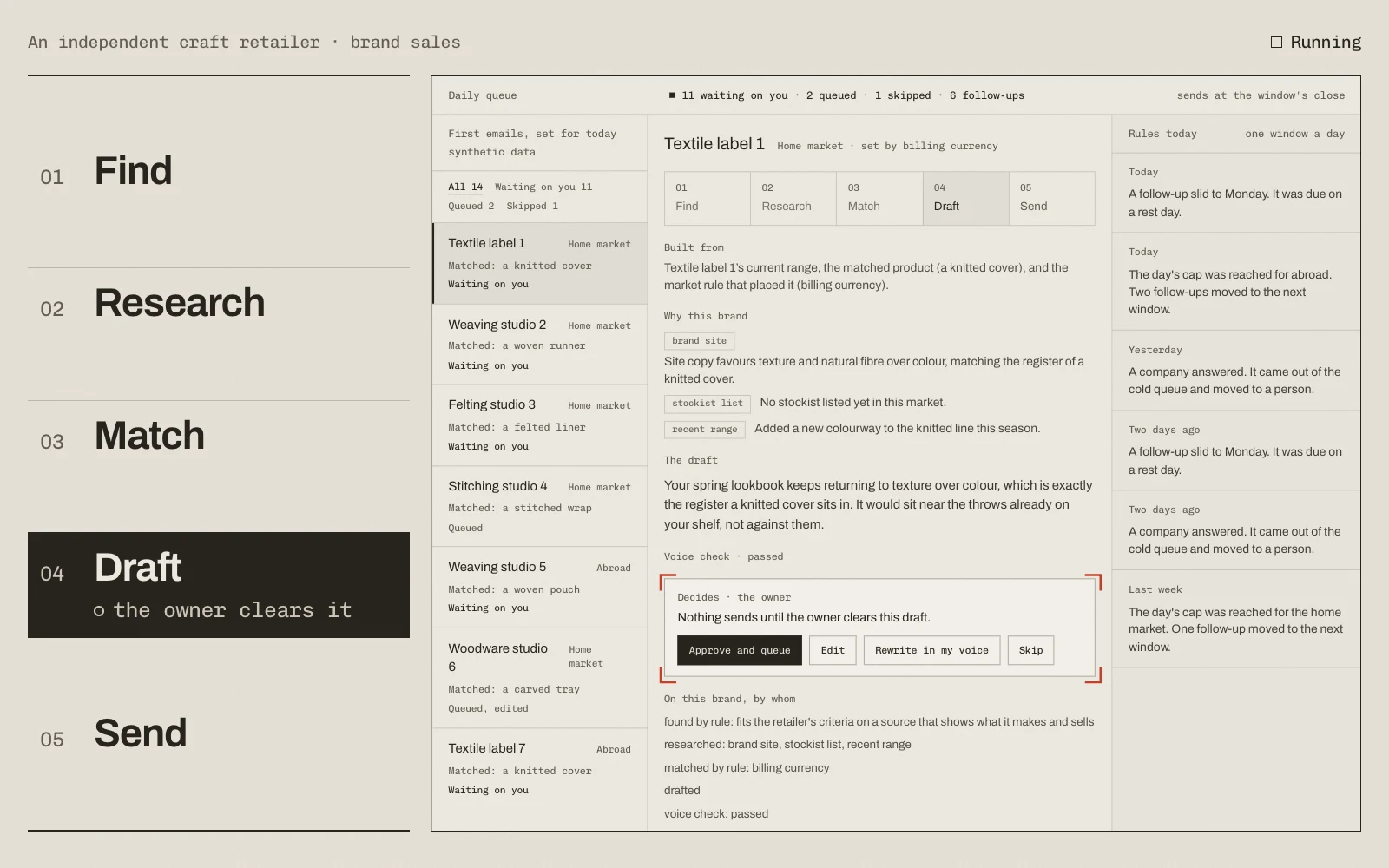
An independent craft retailer · brand sales
Land brand deals from a short list of the right companies.
Each company is researched and gets a drafted first email; a separate sender is the only part allowed to send.
Read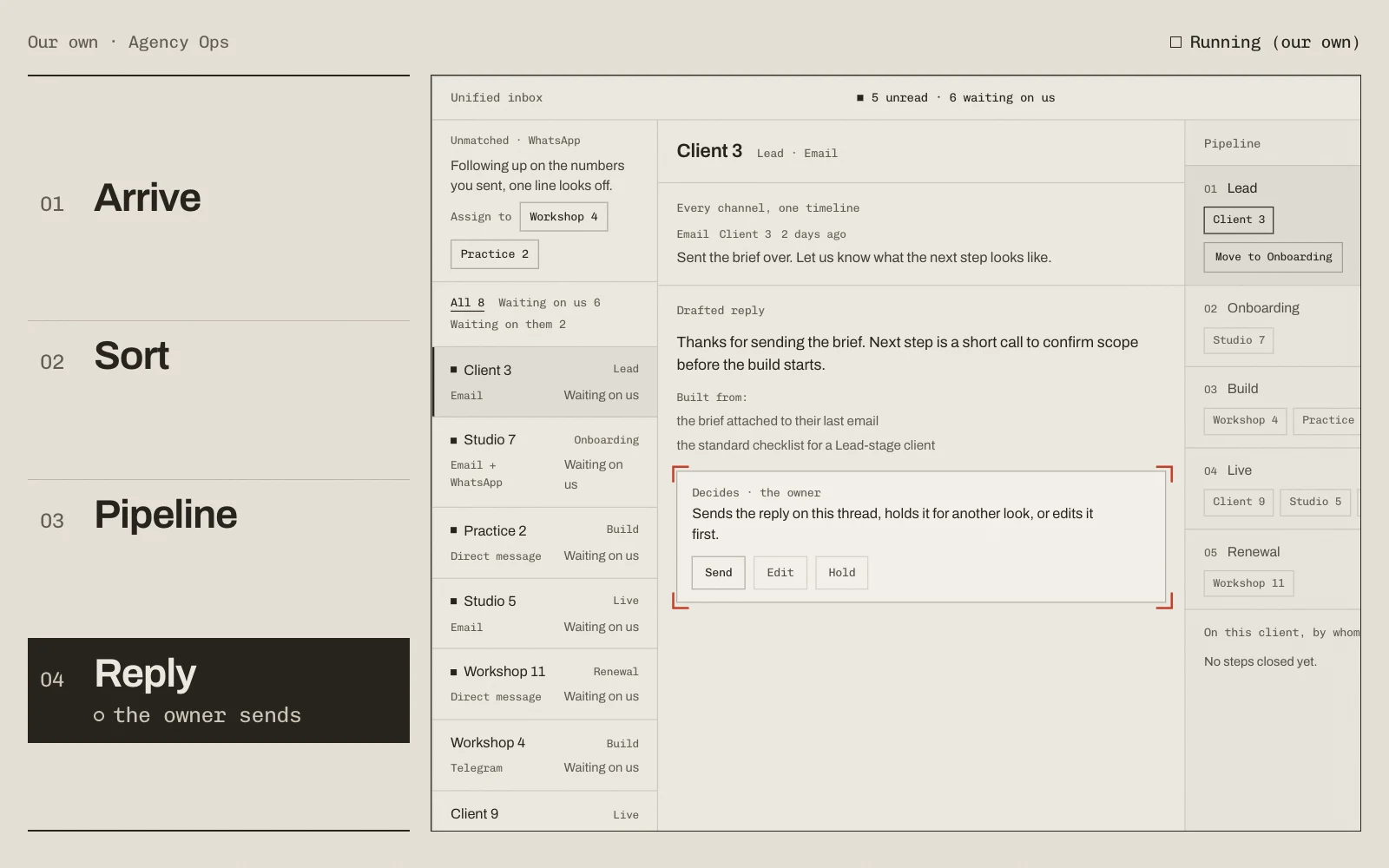
Our own · Agency Ops
Answer every client from one inbox, whichever channel they wrote on.
Email, chat and direct messages land in one record, sorted as they arrive, with the pipeline kept on the same data.
Read
What people ask before they write in.
Does everything need automating?
No. Some work is better done by a person, and the Consult says which. If nothing in your company is worth building a system for, we say so, and the map and baseline are still yours.
Does this replace our people?
No. The agents take on the repeat work, so the same team carries more without hiring to match. Each agent moves up only when your team has seen it work, and can be stepped back at any point. Your people keep the decisions, the relationships and the creative calls.
How do you measure whether it works?
Against the baseline from your Consult. Before anything is built we measure how the work runs today, and the system is judged against that.
Can we start with one team?
Yes. One system is a real way in: the Consult maps that work and fixes one price for its build. As a partner, the whole package is built side by side, with go-live staged so nothing breaks, and our team stays to run it.
How is it priced?
The Consult first, then one fixed price, in writing. The Consult is paid, and what it finds sets the price of the build, so you know the whole cost before anything is built. Running it after launch is a monthly fee.
Every post belongs to one topic.
- Build or buyBuild or buy, what it costs, and what to ask before anyone builds you anything. (6)
- Client contextThe work of reassembling who a client is before every next touchpoint, and how to stop doing it. (6)
- Automation that holds upSilent failures, gates, rollbacks and the checks that keep a running system honest. (4)
- Founder operationsCounting the hours that never needed a human, and deciding what to hand to a system first. (5)
- Growth systemsContent and outbound that keep running when the founder is busy, and still sound like the company. (2)
- Operations systemsIntake, handoffs and status carried by one system, so the team keeps the judgement calls. (3)
- Product systemsA model inside a product: speed, fallbacks, keys, and what running it costs after launch. (2)
Bring the version of this that is about your company.
The first conversation is with the people who would build it. If there is a fit, the Consult comes next.