How many hours a week is your team spending on this workflow?
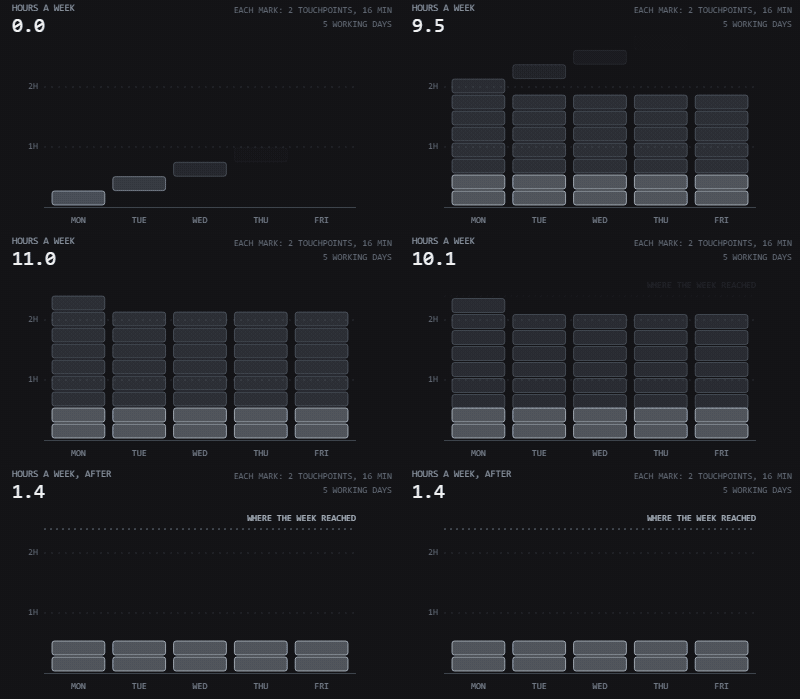
Your real cost is hours a week, not licence price. Multiply your clients by the touchpoints each one takes in a cycle, then by the minutes somebody spends rebuilding context before each touchpoint. The number is usually larger than anyone expected, and licences are the small part. Put your three numbers in and the rest follows.
The arithmetic, on your own numbers
On your numbers the built version has cost less in total by month 15, counting the one-off budget, the licences at your own increase rate, runtime, and the hours at $45 each.
today, cumulativebuilt, cumulative
At 10,000 runs a month you are doing about 329 a day. That is the volume where per-task pricing, provider rate limits and debugging all change character at once. What changes at that volume →
What the six lines mean
Most cost comparisons stop at the first one, and the buyer meets the rest in year two.
- Licence cost. Seats times per-seat price, plus the flat platform fee.
- Licence-increase exposure. The same licences in year three, at the annual increase from your own renewals.
- Maintenance attention. Hours a month first, because hours are the unit this is really paid in.
- Runtime cost. Model, API and hosting spend. It does not go away when you build.
- Dependency count. Every third party is a price change, an outage and a terms update you do not control.
- Cost to change at six months. Not a number. Four buckets: configuration, a contained code change, a large one, a rebuild.
Why there is no price on this page
A comparison that quotes somebody else's prices is wrong within a quarter and arguable the moment it is published, because your plan, your region and your contract are not the ones that got quoted. Worse, a reader who catches one stale figure reads every other number on the site as a sales artefact.
There is no OCTYN price in the model either. The build column takes a budget you enter and reports the month it pays back. A calculator that pre-fills its own seller's price has stopped being a model.
Where to read your own numbers
Take the figures off your own invoices first. Where you need a public rate card, these are the pages to read, and no figure from any of them is copied onto this page. Each URL was loaded and returned a live page on 2026-09-14.
- Zapier pricing: task-based tiers, read the one your account is on
- n8n pricing: execution-based tiers and the self-hosted option
- OpenAI API pricing: per-token rates for the model you actually call
- Anthropic pricing: per-token rates, and the batch and caching discounts
- Groq pricing: per-token rates on the open models
- Deepgram pricing: per-minute speech rates if voice is in the chain
- Supabase pricing: database, auth and edge function tiers
The line this model cannot price
Cost to change at six months is the sixth dimension and it is deliberately not a number. It is a bucket: configuration, a contained code change, a large one, or a rebuild. Ask whoever is quoting you which bucket your three most likely changes land in, and whether they will tell you the expensive answer when it is the true one.
Bring the numbers you just typed. The consult starts from those.
Book a call →