
Marine servicesA fleet manager answers the companies they already know.
What can a system carry in a marine services business?
Every fleet manager in a market, reached in the company’s own voice. A marine services company’s contacts split across an existing list and everyone still unfound, and reaching all of them in the owner’s voice used to mean choosing between speed and sounding right. A growth system researches each contact and writes to every one of them the same way.
How it sounds from inside.
- Some fleet managers are already contacts, and the rest have never heard from the company at all.
- Writing to a new contact in the owner’s own voice takes longer than writing generically, so generic wins by default when time runs short.
- A market’s fleet managers change vessels, routes and roles, and a contact list goes stale before anyone notices.
- A reply from someone who already knows the company and a reply from a stranger need different first messages, and both start from the same list.
Growth systems.
The work is the same shape whether a contact already knows the company or has never heard of it: find who fits, understand them, write to them in one voice, and follow up. That is what a growth system carries: research on every contact whether existing or newly found, written in the owner’s own voice, with a person approving what goes out before it reaches anyone.
The boundaryNothing goes out in the company’s name without clearing the line the company draws: a person’s approval, a check on its voice, or a daily window to read the queue and pull anything.
What a growth system is built fromMarine services, as built.
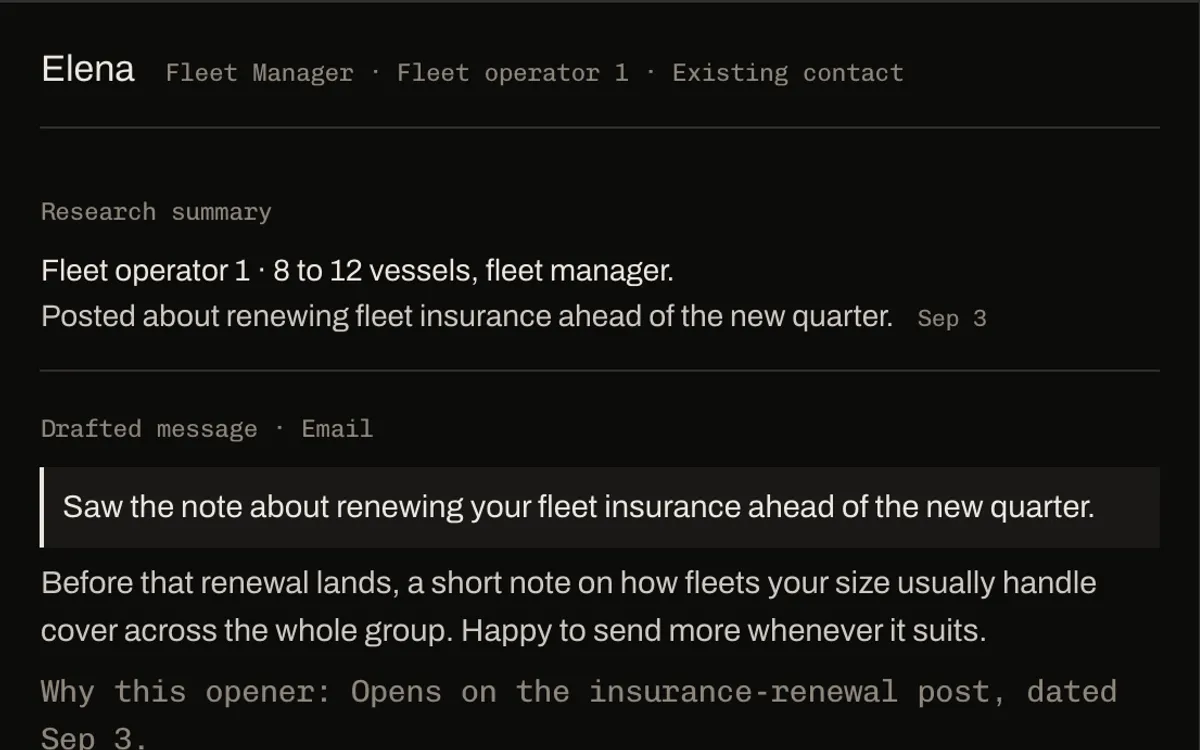
- 01ResearchEach contact, existing or newly found, is researched: the company, the role, and any public signal worth opening with.
- 02PersonalizeA first message is drafted in the owner’s voice, from what the research found.
- 03ReachEmail and the professional network carry the first message and every follow-up.
- 04Follow throughA contact stays in a cadence until they reply or the cadence ends, so a lead never disappears after one message.
- 05Sign offNothing reaches a contact until a person clears it.
- 06TrackEvery contact, every message and every reply lands in one dashboard.
What we would map first.
- Who is already a contact
The company’s existing relationships, and what is already known about each one.
- Who else fits the market
Fleet managers and operators in the market the company hasn’t reached yet.
- Written in one voice
A first message drafted in the owner’s own voice, whether the contact is old or new.
- What a person signs off
Every message a person approves before it goes out in the company’s name.
Before you commission one in marine services.
- Does it write differently to an existing contact than a new one?
- Yes. An existing contact gets a message that reads like it comes from someone who already knows them; a new one gets a first introduction. Both are drafted in the same voice and approved before sending.
- Whose voice does it write in?
- The owner’s. The system is set from what the owner has already written and said, and a person checks anything before it goes out under the company’s name.
- Does it replace the relationships already in place?
- No. It keeps writing to the contacts already there and finds the ones the company hasn’t reached yet; the relationship itself still runs through a person.
Where would it start in your company?
The first conversation is with the people who would build it. If there is a fit, the Consult comes next.