
Trade and logisticsAn order moves as fast as the slowest inbox it passes through.
What can a system carry in a cross-border trading business?
The order itself, from quote to delivery. A cross-border order passes through supplier checks, payment held in escrow, trade finance, shipping, customs and insurance, and each step usually lives in a different inbox or chat thread. An operations system carries the order through every step as one record, and shows the team which orders are stuck and why.
How it sounds from inside.
- Every order is an email chain, and the chain is the only record of where it stands.
- Suppliers, buyers, the bank and the forwarder each need something from us before an order can move.
- Years of trade relationships live in chat threads that one person knows how to read.
- A shipment is stuck, and the first anyone hears of it is the buyer asking where it is.
Operations systems.
The work is the same sequence of steps on every order, with money and commitments at several of them. That is the shape an operations system is built for: one record per order, each step carried from the one before, and every step that moves money or commits you to a buyer left for a person to close.
The boundaryIt works inside limits drawn in the Consult: what it may change, what it only reads, and the steps it hands to a person and never closes.
What an operations system is built fromTrade and logistics, as built.
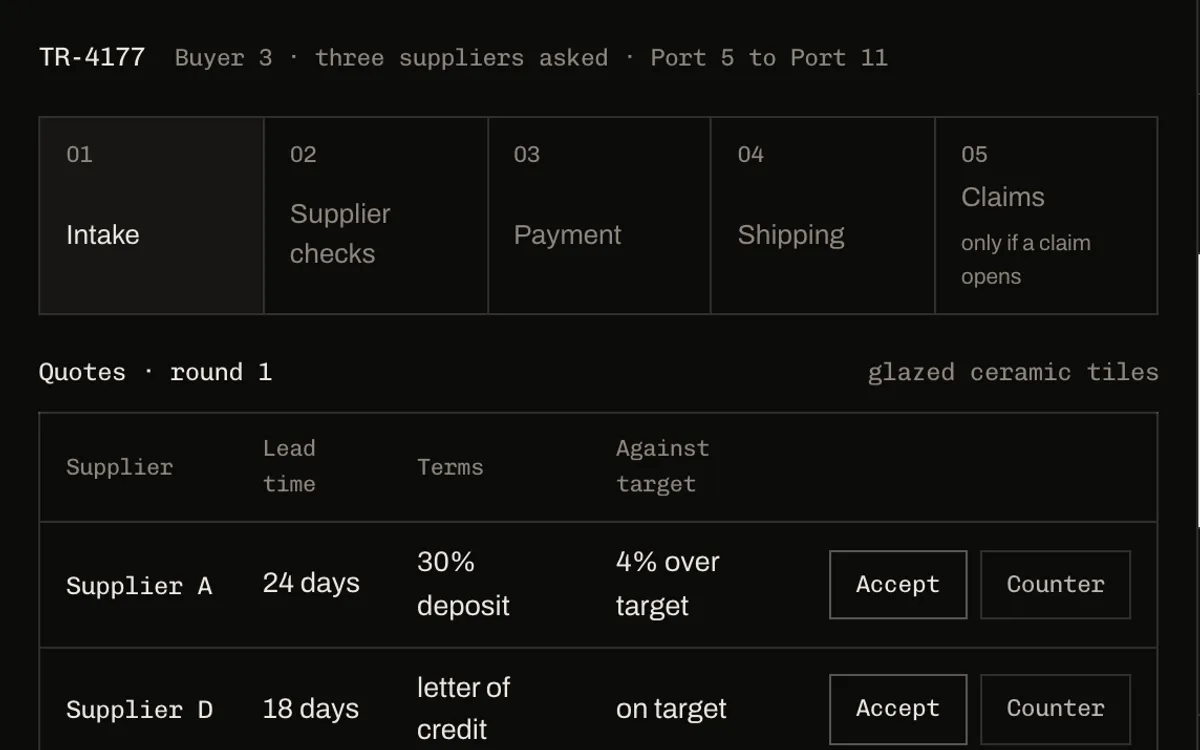
- 01IntakeA buyer’s request becomes one order record: product, quantity, terms and destination.
- 02Supplier checksCertificates, inspection and the supplier’s documents are gathered and checked against the order.
- 03PaymentEscrow or a letter of credit is prepared, with the documents the bank asks for drawn from the order.
- 04ShippingBooking and shipping papers are prepared, and each milestone moves the order forward.
- 05ClaimsA short or damaged delivery opens a claim with the order’s evidence already attached.
- 06Operations viewEvery open order, the step it waits on, and who it waits for.
What we would map first.
- One order, end to end
The path an order takes today, from the buyer’s request to the release of payment, with every hand-off marked.
- Where orders wait
The steps that need a document, a bank, a supplier or an inspection before the order can move.
- What a person closes
Which steps move money or commit you to a buyer, so the system prepares them and waits.
- The morning view
What the team needs to see first thing to know which orders are at risk, and why.
Before you commission one in trade and logistics.
- Does it replace our forwarder, our bank or our insurer?
- No. It carries the order between them. Each keeps doing its own work; the system keeps the record of where every order stands, prepares what each party needs from you, and shows you when one of them is late.
- Who releases payment?
- Whoever you name. Releasing funds, confirming an order to a buyer and accepting a supplier are steps you mark for a person, and the system never closes a step marked that way. It prepares the step and records who closed it.
- Our suppliers work over chat, not a portal. Does that matter?
- It decides where the system starts, not whether it can. The mapping lists every channel an order touches today, and the Consult says which ones the system reads directly and which stay with a person for now.
Where would it start in your company?
The first conversation is with the people who would build it. If there is a fit, the Consult comes next.